
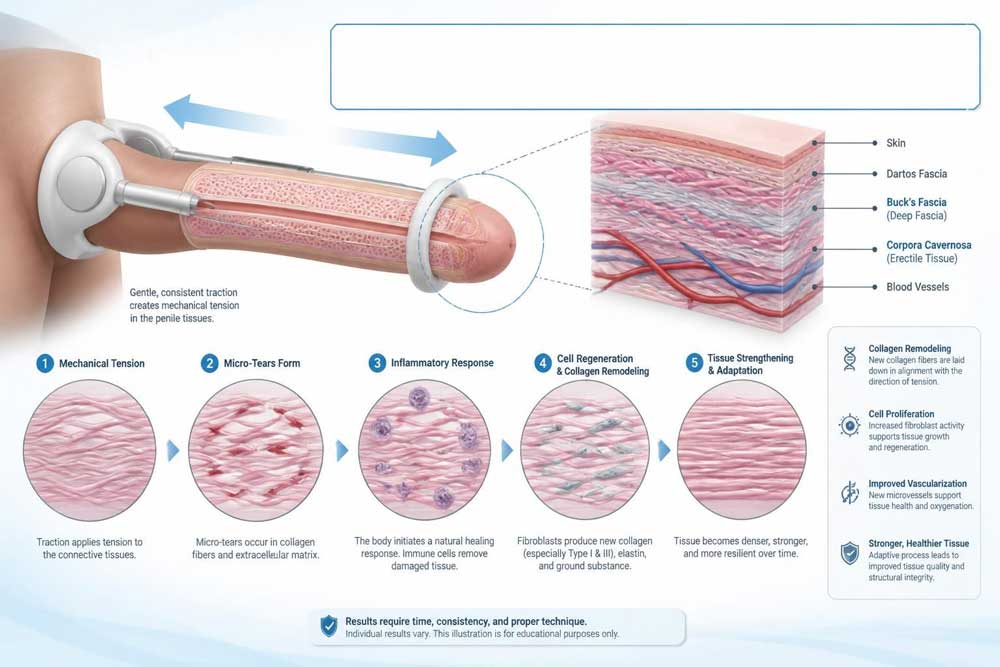
Micro-Tears and Cell Regeneration: The Real Science Behind Traction-Based Enlargement
There’s a lot of noise on the internet when it comes to penis enlargement. Bold claims, dubious products, and outright myths make it genuinely difficult to figure out what’s real. But underneath all the marketing fluff, there is actual biology at work, and understanding it changes how you think about traction-based methods entirely.
This article breaks down the science behind how traction devices work, what happens to penile tissue at the cellular level, and how the mechanism mirrors processes used in legitimate medical fields around the world.
What Actually Happens When You Apply Traction?
Most people assume traction devices work through some kind of mechanical stretching – that you’re simply pulling tissue until it gets longer, the way you might stretch a rubber band. That’s an understandable assumption, but it’s not quite accurate.
What actually happens is more sophisticated. When a consistent, gentle force is applied to tissue over time, the body interprets that force as a signal. Specifically, cells within the tissue experience what scientists call mechanotransduction – the process by which physical forces are converted into biochemical signals. In plain terms: your cells sense the tension and respond to it.
That response triggers a cascade of biological events. It doesn’t happen overnight. But over weeks and months of consistent application, real structural change can occur.
The Role of Micro-Tears in Tissue Expansion
Here’s where it gets interesting. When traction is applied, the tissue doesn’t just passively stretch. At a microscopic level, small separations occur between cells – what researchers refer to as micro-tears. These are not injuries in the usual sense. They’re better described as controlled, minimal stress points within the tissue matrix.
These micro-tears are actually the trigger for growth. The body detects them and initiates a repair response. Fibroblast cells rush to the area and begin producing new collagen and connective tissue to “fill in” the gap left by the separation. Over time, this repeated cycle – tension, micro-separation, repair, new tissue formation – leads to a measurable increase in tissue volume and length.
This process is not unique to penile tissue. It’s the same fundamental mechanism behind:
- Ilizarov bone distraction – a surgical technique used in orthopedics to lengthen limbs by gradually separating bone and allowing new bone tissue to form in the gap.
- Tissue expansion in reconstructive surgery – where balloons are placed under the skin and slowly inflated over weeks to grow new skin for grafting.
- Neck elongation practices in certain cultures – where rings are added incrementally over years, and the soft tissue genuinely lengthens through sustained mechanical load.
The biology is consistent. Sustained, controlled tension stimulates new tissue growth. This is not a theory – it’s a well-documented physiological response.
Understanding the Penile Tissue Structure
To understand why traction works specifically on penile tissue, it helps to know what that tissue is made of. The penis contains two cylindrical chambers called the corpora cavernosa, which are responsible for erections. Surrounding these chambers is a tough, fibrous sheath called the tunica albuginea.
The tunica albuginea is largely composed of collagen fibers arranged in a complex, layered pattern. It’s this structure that determines much of the penis’s size and shape – both in its flaccid and erect state. When traction is applied consistently, it’s this fibrous tissue that responds most directly to the mechanical stimulus.
The collagen fibers can remodel under sustained load. New fibroblasts deposit fresh collagen in the direction of the applied force, gradually expanding the tissue matrix. Over time, this means the tunica can accommodate more volume – which translates to measurable changes in both length and, to some extent, girth.
Why Consistency and Gradualism Matter So Much
One of the most important – and most commonly misunderstood – aspects of traction-based enlargement is that it demands consistency over intensity. Applying too much force too quickly doesn’t accelerate growth. It causes actual injury, which triggers a very different kind of repair response – one that leads to scar tissue formation rather than healthy new tissue.
Scar tissue is less elastic, less vascular, and structurally weaker than the original tissue. This is exactly what you don’t want. It’s also one of the reasons poorly designed devices or improper technique can make things worse rather than better.
The optimal approach is gradual, measured tension applied over extended periods. Think weeks and months, not days. The tissue needs time to complete each repair cycle before the next round of micro-stress is introduced. This is the same logic behind progressive overload in strength training – you increase resistance incrementally to allow the body to adapt, rather than maxing out immediately and tearing a muscle.
For a deeper look at how these principles translate into a clinically structured treatment protocol, the principle of medical traction explains the mechanical and biological reasoning behind properly designed traction therapy.
The Cellular Biology of Tissue Remodeling
Let’s go one layer deeper. At the cellular level, the process of traction-induced tissue remodeling involves several key players.
- Fibroblasts are the primary cells responsible for producing collagen. When they sense mechanical stress through membrane receptors, they activate and begin synthesizing new extracellular matrix components. This matrix – the structural scaffolding between cells – is what physically expands as new material is laid down.
- Growth factors also play a significant role. Mechanical loading stimulates the release of compounds like TGF-beta (Transforming Growth Factor Beta), which promotes collagen synthesis and cell proliferation. These aren’t exotic substances – they’re part of the body’s normal wound-healing and adaptation toolkit.
Interestingly, studies on tendon and ligament adaptation to mechanical load – tissues structurally similar to the tunica albuginea – show that collagen turnover increases significantly under chronic tensile stress. This is particularly well documented in research on connective tissue mechanobiology, which highlights how fibroblast activity and matrix remodeling are directly influenced by physical forces.
The implication is clear: the tissue doesn’t just stretch passively. It literally grows in response to sustained traction.
How Medical-Grade Devices Translate Science Into Practice
Understanding the biology is one thing. The practical challenge is applying traction in a way that’s precise, consistent, safe, and comfortable enough to use daily over an extended period. This is exactly where device quality matters enormously.
A well-designed penile traction device does several things correctly. It distributes tension evenly across the shaft rather than concentrating it at one point. It allows for adjustable, incremental force increases as tolerance builds. And it’s comfortable enough that wearing it for the recommended daily duration – typically several hours – doesn’t become an ordeal.
Andromedical’s Andropenis device was developed with these principles at its core. It’s one of the most clinically studied penile extenders available, with published research supporting its effectiveness for both size improvement and penile curvature correction in conditions like Peyronie’s disease. It’s not a gimmick – it’s a device built around the same mechanobiological principles described throughout this article.
For those dealing specifically with Peyronie’s Disease – a condition characterized by scar tissue plaques that cause painful curvature – the Andropeyronie device applies targeted traction to help address fibrous plaques while encouraging healthy tissue remodeling. The science is the same; the application is adapted to the specific anatomical issue.
What the Research Actually Shows
Clinical evidence for traction-based enlargement has been accumulating for years. Multiple peer-reviewed studies have measured penile length changes following consistent use of traction devices over three to six months, with results generally showing gains in both flaccid and stretched penile length.
A commonly cited figure from clinical trials using devices like the Andropenis is an average gain of approximately 1.5 to 2.5 centimeters in stretched length after sustained use. These are modest numbers – but they’re real, reproducible, and statistically significant in controlled studies.
Anyone promising dramatic changes in a matter of weeks is selling something the biology doesn’t support.
It’s also worth noting that results vary based on starting anatomy, consistency of use, daily wear time, and adherence to proper technique. The biology is reliable – but it requires the right inputs.
Common Misconceptions Worth Addressing
- “Traction just stretches the skin, not the actual tissue.”
This misunderstands the anatomy. Properly applied traction targets the internal structures – particularly the tunica albuginea and the corpora cavernosa – not just the outer skin layer. The skin adapts as well, but it’s the internal tissue remodeling that drives structural change.
- “Results are temporary.”
This conflates traction with simple elastic stretching. Because the results come from actual new tissue formation – new collagen deposited by fibroblasts – they are structural and lasting. The tissue that forms doesn’t disappear when you stop using the device, any more than new bone formed through distraction osteogenesis reverts when the fixator is removed.
- “More tension means faster results.”
As covered earlier, this is incorrect and potentially harmful. Excessive force bypasses the controlled micro-tear and repair cycle, triggering scar formation instead of healthy growth. The mechanism is dose-dependent, and the dose has an optimal range.
Who Is This Approach Most Appropriate For?
Traction-based therapy is particularly well-suited for men who want a non-surgical, non-pharmaceutical path to either size improvement or curvature correction. It’s also commonly used post-surgery – for example, after prostate surgery or penile procedures – to maintain length and support tissue recovery. Andromedical’s Androsurgery extender is specifically designed for this post-operative purpose.
It is not a quick fix, and it’s not right for everyone. Men with certain vascular conditions, active infections, or unmanaged Peyronie’s plaques may need medical guidance before starting. But for the majority of healthy men with realistic expectations, the biology is clearly on their side.
The Bigger Picture: Why Understanding the Science Matters
There’s a reason so many men feel skeptical about this category of products. The market has been polluted by exaggerated claims, low-quality devices, and a general lack of transparency about how any of this actually works. When something sounds too good to be true, healthy skepticism is warranted.
But that skepticism shouldn’t lead to dismissing legitimate, well-documented biology.
Traction-induced tissue remodeling is not pseudoscience. It’s a mechanism that plastic surgeons, orthopedic specialists, and reconstructive physicians rely on routinely. The application to penile tissue follows the same rules.
Understanding the mechanism – micro-tears, fibroblast activation, collagen synthesis, and controlled tissue expansion – puts you in a position to evaluate products and claims with real criteria instead of just hope or cynicism.
Conclusion: Real Biology, Real Decisions
If you’ve made it this far, you now understand something most people interested in this topic never bother to learn: the actual cellular and structural mechanisms that make traction-based enlargement possible. It’s not magic. It’s not a scam. And it’s not simply “stretching.” It’s a specific biological response to a specific type of mechanical stimulus – one that requires time, consistency, and a properly engineered device to work correctly.
The science is solid. The results are real when the protocol is followed correctly. What separates success from failure in this space is almost always the quality of the device and the consistency of the user.
If you’re ready to move from understanding the science to applying it, exploring Andromedical’s clinically validated product line is a logical next step. Whether your goal is size improvement, curvature correction, post-surgical recovery, or improved erectile function, the devices are built around the same mechanobiological principles discussed throughout this article. You can also explore the full context of what’s possible with a comprehensive guide to penis enlargement to make an informed decision about where to start.
The biology is on your side. The rest is consistency.