
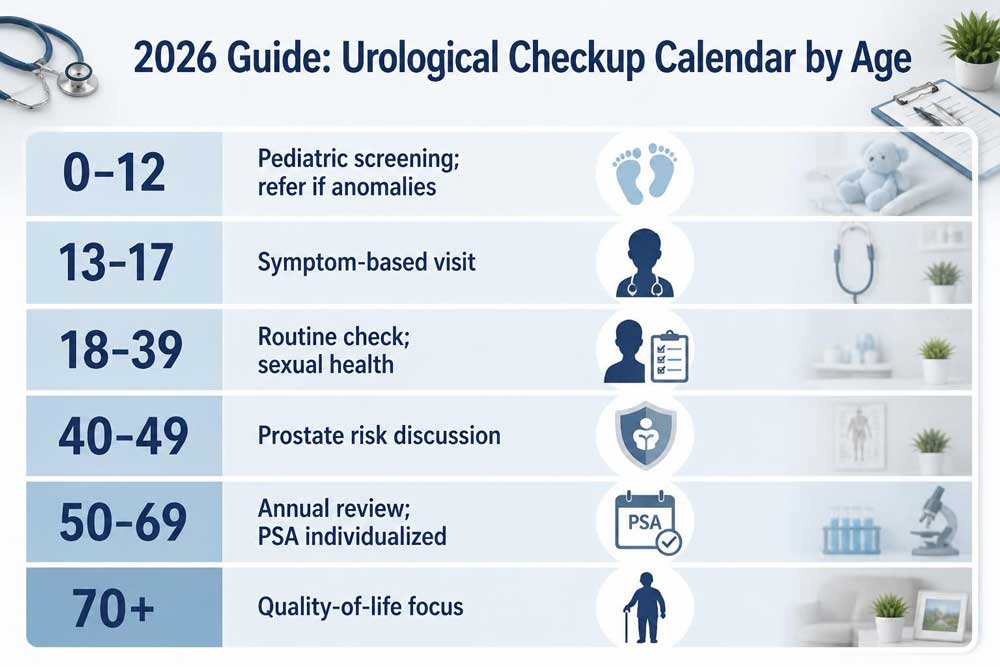
2026 Guide: Urological Checkup Calendar by Age
Most men are good at ignoring things they would rather not think about. Urological health tends to fall squarely in that category. It is not a topic that comes up at dinner, and for many men, the doctor’s office is somewhere they only visit when something has already gone wrong.
That approach has real consequences. Conditions like prostate cancer, erectile dysfunction, kidney disease, and testicular issues are far more treatable when caught early. The challenge is knowing what to look for, and when.
This guide breaks down a practical urological checkup calendar by age, so you know exactly what screenings and conversations to prioritize at each stage of life. Think of it as a roadmap, not a reason to panic.
Why Urological Health Deserves a Scheduled Approach
The urological system covers the kidneys, bladder, ureters, urethra, and, in men, the prostate and reproductive organs. That is a lot of ground, and different parts of that system become more vulnerable at different points in life.
Younger men often assume urological issues are something to worry about later. Older men sometimes assume the problems they are experiencing are just part of aging and not worth mentioning. Both assumptions lead to the same outcome: delayed care that could have made a meaningful difference.
A scheduled, age-appropriate approach changes that. It gives men a framework for proactive conversations with their doctors, and it removes the guesswork about what actually needs attention and when.
Your Urological Checkup Calendar, Broken Down by Age
In Your 20s: Building Awareness and Baseline Health
Your 20s are not a time to ignore your body, even if nothing feels wrong. This is when healthy habits get established, and when certain conditions that tend to go unnoticed can first appear.
Testicular health is the primary urological concern in this decade. Testicular cancer is most common in men between 15 and 35, making self-examination a genuinely important habit.
Monthly self-checks take less than two minutes and can catch changes in size, shape, or texture early.
A general physical during your 20s should also include a conversation about any urinary symptoms, like difficulty starting or stopping urination, urinary frequency or urgency, or discomfort. These are rarely serious at this age, but they are worth flagging.
Blood pressure and kidney function are also worth establishing as baselines. Chronic kidney disease develops quietly over years, and knowing your numbers early gives you something meaningful to compare against later.
In Your 30s: Monitoring Risk Factors More Closely
By your 30s, lifestyle factors start to show up in health markers. Obesity, high blood pressure, diabetes, and heavy alcohol use all affect urological health, particularly kidney function and erectile function.
This is also a decade when erectile dysfunction can begin appearing, often linked to cardiovascular or hormonal issues rather than anything purely psychological. If you are experiencing persistent difficulty with erections, it is worth discussing with a doctor rather than dismissing it. Lifestyle factors, hormonal changes, and medication side effects are treatable contributors. There are medically validated, non‑surgical options that can help address these issues without additional medication.
Men with a family history of prostate cancer should begin talking with their doctor about when to start PSA (prostate-specific antigen) screening. For most men, formal prostate screening begins later, but family history can shift that timeline significantly.
A urinalysis during a routine checkup is a simple, low-cost way to catch early signs of kidney problems, bladder issues, or infection, and it should be part of any annual physical during this decade.
In Your 40s: The Decade to Take Seriously
The 40s are when urological health demands more active attention. The prostate begins to enlarge for many men during this period, a condition called benign prostatic hyperplasia (BPH). It is not cancer, but it can cause real disruption, including frequent urination, weak urine flow, and the feeling that the bladder never fully empties.
If you are experiencing any of these symptoms, a urologist can assess whether treatment or monitoring is appropriate. Many men go years without mentioning these symptoms because they assume they are normal. They are common, but they are not something you have to simply live with.
PSA screening conversations should begin in earnest during your 40s, particularly for Black men and those with a first-degree relative diagnosed with prostate cancer. According to the American Cancer Society, these groups face a higher lifetime risk and may benefit from earlier and more frequent testing.
Kidney stone risk also climbs during this decade, often linked to diet, hydration, and metabolic changes. If you have had a kidney stone before, your urologist may recommend dietary adjustments or medication to reduce recurrence.
In Your 50s: Prostate Screening Becomes Standard
For most men without specific risk factors, the 50s are when prostate cancer screening becomes a routine conversation. The PSA blood test, sometimes combined with a digital rectal exam, gives doctors important information about prostate health.
It is worth understanding what a PSA result actually means. Elevated PSA does not automatically mean cancer. It can reflect BPH, infection, or inflammation. What matters is the trend over time and the broader clinical picture, which is why beginning regular testing creates a useful baseline.
Bladder health also deserves attention during this decade. Bladder cancer is more common in men than women, and smokers carry a significantly elevated risk. Blood in the urine, even if it only appears once, should never be ignored and warrants prompt evaluation.
This is also a time when many men begin noticing changes in sexual function. Erectile dysfunction becomes more prevalent with age, but it is not inevitable. Lifestyle factors, hormonal changes, and medication side effects are all treatable contributors, and there are medically validated options that do not require surgery or medications to address.
In Your 60s: Managing Complexity and Staying Ahead of Disease
By your 60s, the conversation shifts from prevention to active management for many men.
Prostate conditions, bladder changes, kidney function, and sexual health all require ongoing monitoring rather than periodic check-ins.
Annual PSA testing is typically recommended for men in this age group who are in good health and have a life expectancy of at least ten years. For those who have already been treated for prostate issues, follow-up with a urologist should be consistent and structured.
Incontinence is another topic that often goes undiscussed because men find it embarrassing.
But urinary incontinence affects millions of men, and there are effective treatments ranging from pelvic floor exercises to medication to minimally invasive procedures. Staying silent means missing out on options that could restore a significant degree of daily comfort.
Men who have undergone prostate surgery should pay close attention to their recovery trajectory. The post-prostatectomy recovery process involves monitoring urinary leakage, erectile function recovery, and PSA levels. Having the right support tools during recovery can meaningfully improve outcomes.
In Your 70s and Beyond: Quality of Life as the Central Goal
Urological care in later decades is heavily oriented around quality of life. The goal is not necessarily aggressive screening or intervention, but ensuring that symptoms are not silently reducing your comfort, independence, or dignity.
Urinary frequency, urgency, and incontinence become more common with age, but they remain manageable with the right approach. A urologist who specializes in geriatric care or men’s health can help you weigh treatment options in the context of your overall health picture.
Kidney function naturally declines with age, which means medications that were previously safe may need to be monitored more carefully, and hydration becomes more important. A regular check of kidney function through blood work is a simple but meaningful part of staying well.
Sexual health in your 70s is also a valid and legitimate concern. Many men in this age group remain sexually active and experience distress when function changes. There is no age at which these conversations stop being relevant.
Conditions That Can Arise at Any Age
Some urological concerns are not age-specific. Urinary tract infections, sexually transmitted infections, kidney stones, and varicoceles can appear across a wide range of ages. Any persistent urinary symptoms, unusual discharge, pain during urination, or blood in the urine should be evaluated regardless of how old you are.
Peyronie’s Disease, a condition involving the development of scar tissue inside the penis that causes curved, painful erections, can affect men from their 30s onward. It is underdiagnosed because many men do not know it has a name or realize that treatment exists. Traction-based devices and other non-surgical approaches can help manage it effectively when identified early.
How Andromedical Supports Men Through Each Stage
Andromedical works with men navigating real urological health challenges, from Peyronie’s Disease and erectile dysfunction to recovery after prostate or penile surgery. The company’s medical-grade devices, including penile traction devices, surgical extenders, and vacuum pumps, are clinically tested and designed to offer non-invasive, evidence-backed support.
Men exploring prostate and penile surgery options often have questions about what comes before and after surgical intervention. Andromedical provides both the tools and the guidance to support recovery in a meaningful way, always with a focus on patient safety and practical outcomes.
The company does not take a one-size-fits-all approach. Its support team helps men identify the right device based on their specific condition, goals, and medical background, whether they are dealing with curvature correction, size concerns, or post-surgical recovery needs.
Frequently Asked Questions
At what age should men start getting prostate screenings?
Most guidelines recommend beginning PSA screening discussions at age 50 for men at average risk. Black men and those with a family history of prostate cancer should start the conversation at 40 or 45.
Is erectile dysfunction normal with aging?
ED becomes more common with age, but it is not an inevitable part of getting older. It is often tied to cardiovascular health, hormone levels, or medication side effects, all of which can be addressed.
How often should a man see a urologist?
For most men without existing conditions, a urological evaluation every one to two years makes sense from their 40s onward. Men with diagnosed conditions or elevated risk factors may need
more frequent visits.
Can Peyronie’s Disease be treated without surgery?
Yes. Penile traction therapy and other non-surgical approaches have demonstrated meaningful results in reducing curvature and pain associated with Peyronie’s Disease, particularly when started early.
What symptoms should prompt an immediate urological visit?
Blood in the urine, severe pain in the lower back or groin, sudden inability to urinate, or unusual lumps in the testicular area all warrant prompt evaluation without delay.
Take Charge of Your Urological Health Starting Now
Urological health is not something to put on the back burner until something forces the issue.
The checkup calendar outlined here is not about creating anxiety. It is about giving you a clear, manageable plan for staying ahead of conditions that are genuinely treatable when caught at the right time.
Whether you are in your 20s establishing baseline health or in your 60s managing a more complex picture, the path forward starts with regular, honest conversations with a qualified healthcare provider. And for men dealing with specific challenges like Peyronie’s Disease, erectile dysfunction, or surgical recovery, knowing that effective non-surgical options exist is itself a meaningful starting point.
Andromedical is here for exactly those conversations. Explore what is available, ask the questions you have been putting off, and take the next step toward better urological health on your own terms.