
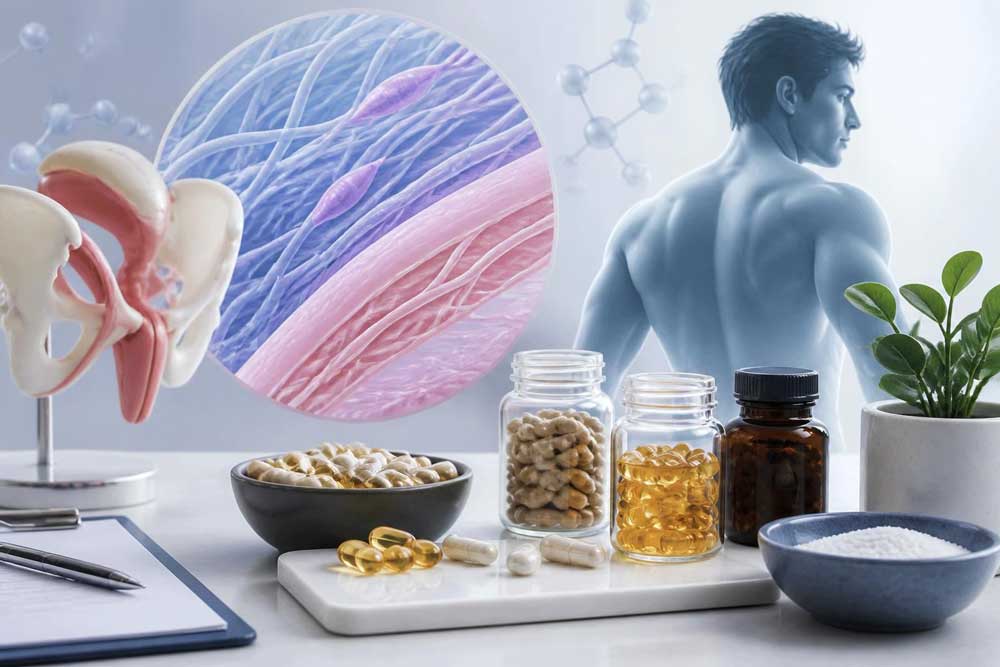
Tissue Health: Essential Vitamins and Minerals for Men with Peyronie’s Disease
Peyronie’s Disease is one of those conditions that many men quietly struggle with, often unsure where to turn or what to do. The curved or bent erection, the discomfort, the uncertainty about intimacy – it takes a real toll. But while medical devices and clinical treatments are central to managing the condition, there is a piece of the puzzle that often gets overlooked: nutritional support for tissue health.
The penile plaque that characterizes Peyronie’s Disease is essentially a build-up of fibrous scar tissue. That means anything that helps the body manage inflammation, support collagen structure, or repair damaged connective tissue becomes directly relevant. Certain vitamins and minerals play a surprisingly important role in this process – not as a cure, but as meaningful support that can work alongside other therapies.
This article breaks down exactly what those nutrients are, why they matter, and how they fit into a broader approach to managing Peyronie’s Disease.
Why Nutrition Matters in Peyronie’s Disease
To understand why certain nutrients help, it helps to understand what is actually happening in the body. Peyronie’s Disease develops when fibrous plaques form inside the tunica albuginea – the dense tissue that surrounds the erectile chambers of the penis. This scarring typically follows trauma or micro-injury to the tissue, triggering an abnormal wound-healing response.
The result is hardened scar tissue that does not stretch the way healthy tissue does, causing the characteristic curve or indentation during erection.
Nutrition does not reverse this scarring on its own. But several vitamins and minerals directly influence the processes involved – inflammation, collagen formation, oxidative stress, and tissue remodeling. When the body is well-supported nutritionally, it is better equipped to manage these processes in a healthier, more controlled way.
Vitamin E: The Most Studied Supplement for Peyronie’s Disease
If you have researched Peyronie’s Disease at all, you have likely come across Vitamin E. It is, historically, the most widely discussed supplement in this context – and for good reason.
How Vitamin E Supports Connective Tissue
Vitamin E is a fat-soluble antioxidant that helps neutralize free radicals – the unstable molecules that drive oxidative stress and tissue damage. In the context of Peyronie’s Disease, oxidative stress plays a meaningful role in the abnormal scarring process. By reducing oxidative damage, Vitamin E may help limit the progression of plaque formation and support healthier tissue repair.
Some early clinical studies showed modest improvements in plaque size and penile curvature with oral Vitamin E supplementation, though more recent research has produced mixed results.
The current consensus is that Vitamin E alone is unlikely to resolve the condition but may contribute as part of a combined approach.
Good dietary sources of Vitamin E include almonds, sunflower seeds, wheat germ oil, and spinach.
Vitamin C and Collagen: A Critical Connection
Vitamin C is essential for collagen synthesis, full stop. Collagen is the structural protein that makes up connective tissue throughout the body, including the tunica albuginea. Without adequate Vitamin C, the body cannot properly build or repair collagen.
Why This Is Directly Relevant to Peyronie’s Disease
When the scar tissue in Peyronie’s Disease forms, it is partly a result of dysregulated collagen production. The fibrous plaque is made up of abnormal collagen deposits that are denser and less flexible than healthy tissue. Supporting normal collagen metabolism through adequate Vitamin C intake does not undo existing plaques, but it may support the surrounding tissue’s structural integrity.
Vitamin C also functions as an antioxidant, giving it a dual role in reducing oxidative damage while simultaneously supporting connective tissue repair.
Citrus fruits, bell peppers, strawberries, and broccoli are all strong dietary sources. For those not getting enough through diet, a daily supplement is an easy addition.
B Vitamins: Supporting Circulation and Nerve Function
The B vitamin family covers a wide range of metabolic functions, but a few members stand out as particularly relevant for men managing Peyronie’s Disease.
Vitamin B3 (Niacinamide)
Niacinamide, a form of Vitamin B3, has been studied specifically in relation to Peyronie’s Disease. Some research suggests it may reduce inflammation and support tissue softening, and it has been used in some treatment protocols, often in relatively high doses under medical supervision.
It is worth noting that high-dose Niacinamide should not be approached casually. It can affect liver function and interact with other medications. Any therapeutic use should be discussed with a doctor first.
Vitamin B9 (Folate) and B12
These two B vitamins are deeply involved in cell division, DNA repair, and vascular health.
Adequate folate and B12 levels support healthy blood flow and cell renewal in penile tissue, which matters both for tissue repair and erectile function. Men with Peyronie’s Disease often experience some degree of erectile dysfunction alongside curvature, so vascular support is doubly important.
Magnesium: The Overlooked Mineral for Tissue and Vascular Health
Magnesium is involved in hundreds of biochemical reactions in the body, and it plays a key role in muscle relaxation, vascular tone, and connective tissue function. Despite being critically important, deficiency is remarkably common in men, particularly those who eat a diet heavy in processed foods.
For men with Peyronie’s Disease, magnesium’s relevance is twofold. First, it helps regulate inflammatory responses, which are central to the disease process. Second, it supports smooth muscle relaxation in blood vessels, which contributes to healthier erectile function and blood flow to penile tissue.
Leafy greens, pumpkin seeds, legumes, whole grains, and dark chocolate are all solid sources of dietary magnesium.
Zinc: Immune Function, Testosterone, and Tissue Repair
Zinc is another mineral that pulls significant weight in men’s health. It is essential for immune function, wound healing, testosterone production, and protein synthesis – all of which have relevance when discussing Peyronie’s Disease.
Zinc deficiency can impair the body’s ability to heal tissue effectively, which matters in a condition where the core problem is an abnormal healing response. Zinc also plays a role in regulating enzymes involved in collagen metabolism, which ties back directly to the structural dynamics of the tunica albuginea.
Oysters, red meat, pumpkin seeds, and lentils are among the richest dietary sources of zinc.
Selenium: Antioxidant Mineral That Supports Tissue Integrity
Selenium is a trace mineral that works closely with Vitamin E as part of the body’s antioxidant defense system. It helps protect tissues from oxidative damage, supports the immune system, and plays a role in reducing chronic inflammation.
While selenium-specific research in Peyronie’s Disease is limited, its antioxidant and anti-inflammatory properties make it a meaningful part of a broader nutritional strategy. Most men can meet their selenium needs through dietary sources alone – Brazil nuts are by far the richest single source, with just two or three nuts covering a full day’s requirement. Seafood, eggs, and whole grains also contribute meaningfully.
Coenzyme Q10: Cellular Energy and Antioxidant Support
CoQ10 is not technically a vitamin or mineral – it is a compound the body produces naturally – but it functions similarly to an antioxidant and is commonly discussed alongside nutritional supplements for Peyronie’s Disease.
CoQ10 plays a central role in cellular energy production and helps protect mitochondria from oxidative damage. Some small studies have explored CoQ10 supplementation in men with Peyronie’s Disease, with findings suggesting potential benefits for reducing plaque-related symptoms and inflammation, particularly in the earlier, active phases of the disease.
CoQ10 levels tend to decline with age, which makes supplementation particularly relevant for older men dealing with Peyronie’s Disease.
Omega-3 Fatty Acids: Systemic Anti-Inflammatory Support
Omega-3 fatty acids, found in fatty fish, flaxseeds, walnuts, and fish oil supplements, are among the most well-researched anti-inflammatory nutrients available. Chronic inflammation is a driving factor in many chronic conditions, including the progressive plaque formation seen in active Peyronie’s Disease.
A diet rich in omega-3s or consistent supplementation with high-quality fish oil supports a less inflammatory internal environment, which may help slow plaque progression and support overall tissue health. The Mayo Clinic notes that lifestyle and nutritional factors can play a supportive role alongside formal treatment in men managing Peyronie’s Disease.
How Nutrition Fits Into a Broader Treatment Plan
It is important to be clear: no supplement regimen is going to eliminate Peyronie’s Disease on its own. The condition involves physical structural changes to penile tissue, and managing it effectively typically requires a multi-pronged approach.
Nutritional support works best when combined with evidence-based treatments. Penile traction therapy, for example, is one of the most clinically validated non-surgical approaches to Peyronie’s Disease. The Andropeyronie penile traction device from Andromedical is specifically designed to address penile curvature and plaque-related deformity through consistent, medically guided traction, supporting the kind of tissue remodeling that nutritional interventions alone cannot achieve.
Used together, targeted nutrition and traction therapy can create a more favorable environment for tissue healing and functional improvement.
Practical Guidance: Getting the Most From Nutritional Support
Building a nutrition strategy for tissue health does not need to be complicated. A few practical points are worth keeping in mind.
Food first is generally the right approach. Getting nutrients from whole foods delivers them alongside other compounds – fiber, phytonutrients, co-factors – that support absorption and overall health in ways isolated supplements cannot always replicate.
Where supplementation is appropriate, quality matters. Look for bioavailable forms of nutrients, avoid products with excessive fillers, and be cautious about megadosing without medical guidance – especially with fat-soluble vitamins like A and E, which can accumulate in the body.
A baseline blood panel is a helpful starting point. Knowing whether you are actually deficient in zinc, magnesium, Vitamin D, or B12 takes the guesswork out of supplementation and ensures you are addressing real gaps rather than assumed ones.
Finally, consistency matters more than intensity. Nutritional support is a long game. The goal is to maintain an internal environment that reduces inflammation, supports collagen health, and promotes normal tissue repair over time.
Conclusion
Managing Peyronie’s Disease is a process, and there are no overnight solutions. But understanding how the body repairs tissue – and what it needs to do that job well – puts men in a genuinely stronger position.
Vitamins like C and E, minerals like zinc and magnesium, and compounds like CoQ10 and omega-3 fatty acids each contribute to the biological processes underlying tissue health. They are not replacements for clinical treatment, but they are meaningful allies in supporting the body’s capacity to heal.
If you are navigating Peyronie’s Disease and looking for a structured, medically sound approach that goes beyond supplements, Andromedical offers clinically developed solutions designed specifically for this condition. Explore the options available and take the next step toward managing your condition with confidence – because your health deserves a plan that actually works.