
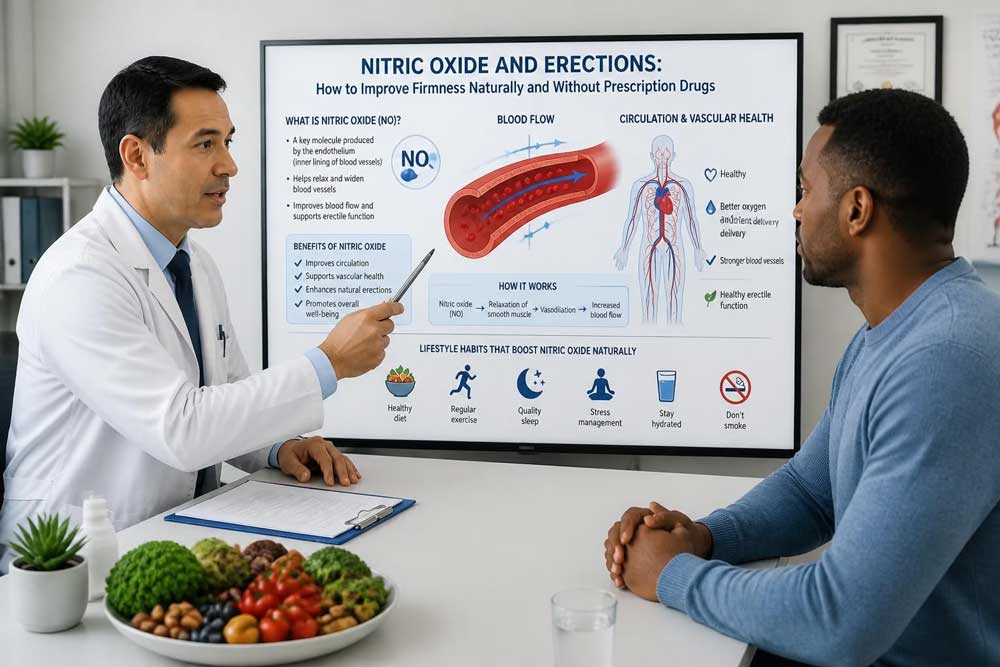
Nitric Oxide and Erections: How to Improve Firmness Naturally Without Prescription Drugs
There is a quiet chemical running the show behind every firm erection, and most men have never heard of it. It is called nitric oxide, and without enough of it, the whole process of getting and maintaining an erection starts to fall apart. The good news is that your body can produce more of it, and there are real, practical ways to help it do that without reaching for a prescription.
This article breaks down exactly what nitric oxide does, why levels drop, and what you can do to restore them naturally.
What Nitric Oxide Actually Does in the Body
Nitric oxide is a signaling molecule, not a drug or a supplement you take directly. Your body synthesizes it from an amino acid called L-arginine, and it plays a central role in how blood vessels behave. When nitric oxide is released into the walls of your blood vessels, it causes them to relax and widen. That process is called vasodilation.
In the context of erections, this matters enormously. When you become aroused, your nervous system triggers the release of nitric oxide in the penile tissue. The smooth muscle in the corpus cavernosum, the two chambers that run the length of the penis, relaxes. Blood floods in.
Pressure builds. An erection forms.
If nitric oxide levels are low, that chain of events gets interrupted. Blood flow is restricted, the chambers do not fill properly, and erections become weak, inconsistent, or absent altogether.
Why Nitric Oxide Levels Decline With Age
This is where a lot of men start connecting the dots. Nitric oxide production is not fixed. It drops as you get older, and certain lifestyle habits accelerate that decline significantly.
Research suggests that nitric oxide bioavailability can fall by as much as 50 percent between your twenties and your forties. That is a substantial change, and it explains why erectile function tends to shift gradually rather than all at once.
The main culprits behind faster decline include smoking, a diet high in processed foods, chronic stress, physical inactivity, and poor cardiovascular health. All of these either impair nitric oxide synthesis or increase oxidative stress, which breaks down nitric oxide before it can do its job.
The endothelium, the thin layer of cells lining your blood vessels, is where most nitric oxide production happens. When that lining becomes damaged or inflamed, it produces less nitric oxide, and vascular function suffers across the board, including in the penis.
How to Boost Nitric Oxide Naturally
Eat More Nitrate-Rich Foods
One of the simplest ways to increase nitric oxide is through diet. Certain vegetables are high in nitrates, which your body converts to nitric oxide through a two-step process involving bacteria in your mouth and stomach acid.
Beetroot is the most well-studied example. Leafy greens like spinach, arugula, and Swiss chard are also high in dietary nitrates. Regular consumption of these foods has been shown to measurably improve blood pressure and blood flow in clinical settings.
Garlic deserves a mention here too. It activates an enzyme called nitric oxide synthase, which is directly responsible for producing nitric oxide in the body. It is not a dramatic fix on its own, but it contributes to a broader nutritional strategy.
Prioritize L-Arginine and L-Citrulline
L-arginine is the direct precursor to nitric oxide. It is found naturally in foods like red meat, chicken, fish, nuts, and dairy. Some men also supplement with it, though the evidence on oral L-arginine supplementation is mixed because much of it gets broken down before it reaches the bloodstream.
L-citrulline is more effective for this reason. Your kidneys convert citrulline into arginine, which means more of it survives to actually drive nitric oxide production. Watermelon is a natural source, and citrulline supplements are widely available. Several studies have shown modest but meaningful improvements in erectile function with citrulline supplementation in men with mild to moderate erectile dysfunction.
Exercise Regularly, Especially Cardiovascular Work
Physical activity is one of the strongest tools for restoring nitric oxide levels. When you exercise, the increased blood flow puts mechanical stress on the walls of your blood vessels. That stress stimulates the endothelium to produce more nitric oxide, essentially training your vascular system to function more efficiently.
Aerobic exercise, the kind that raises your heart rate for a sustained period, is particularly effective. Running, cycling, swimming, and brisk walking all qualify. Aim for at least 150 minutes of moderate aerobic activity per week as a baseline.
There is also growing interest in targeted vascular approaches to penile health. If you want to understand how specific physical training can support girth and vascular performance, the research on vascular exercises to enhance penis girth offers a useful perspective on blood-flow training for erectile tissue.
Reduce Oxidative Stress
Nitric oxide is fragile. Free radicals, unstable molecules produced by inflammation, poor diet, stress, and pollution, destroy nitric oxide before it can reach its target. Reducing oxidative stress is therefore just as important as increasing nitric oxide production in the first place.
Antioxidant-rich foods do the heavy lifting here. Berries, dark chocolate, green tea, and foods high in vitamin C and vitamin E all help neutralize free radicals. Think of antioxidants as bodyguards for your nitric oxide.
Reducing alcohol intake also helps. Alcohol impairs endothelial function and disrupts the hormonal signaling involved in erections, including testosterone, which has a supporting role in nitric oxide production.
Sleep, Stress, and Hormonal Balance
Poor sleep and chronic stress are silently eroding nitric oxide levels in a huge number of men.
During deep sleep, your body releases growth hormone and repairs endothelial cells. Men who sleep fewer than six hours per night consistently show worse cardiovascular markers and lower nitric oxide availability.
Cortisol, the primary stress hormone, interferes with the pathways that produce nitric oxide.
When cortisol is chronically elevated, testosterone drops, endothelial health deteriorates, and the downstream effect on erections is predictable.
Managing stress through physical activity, sleep hygiene, and reducing stimulant overuse is not just good general advice. It is physiologically relevant to erection quality in a very direct way.
Sunlight and Nitric Oxide
This one surprises a lot of people. Your skin stores nitrates and nitrites that are released into circulation when the skin is exposed to UV light. Sunlight essentially mobilizes a reservoir of nitric oxide precursors sitting in your skin tissue.
This does not mean prolonged sun exposure is a treatment plan. But it does reinforce the value of regular outdoor activity and avoiding the kind of entirely sedentary, indoor lifestyle that compounds most of the other risk factors discussed here.
When Lifestyle Changes Are Not Enough
Dietary improvements, exercise, and stress management can meaningfully restore nitric oxide levels for many men. But for some, the underlying vascular or structural issue goes beyond what lifestyle modification alone can fix.
Erectile dysfunction has multiple causes. Sometimes it is primarily hormonal. Sometimes it involves nerve damage from diabetes or post-surgical complications. Sometimes the issue is psychological, even when the physiology is intact. And in some cases, the problem is not nitric oxide production at all but mechanical or structural factors in the penile tissue itself.
That is why it is worth understanding the full range of treatment options for erectile dysfunction before assuming a single approach will cover everything. Medical-grade devices, for example, offer non-invasive solutions that can work alongside lifestyle strategies rather than replacing them.
At Andromedical, the focus has always been on solutions that are clinically validated and medically certified, not quick fixes. Devices like the Androvacuum are designed to support healthy blood flow to penile tissue, which has its own connection to the vascular health principles described throughout this article.
Combining Natural Strategies With Device-Based Support
There is a reason many clinicians recommend combining approaches rather than relying on a single intervention. Nitric oxide optimization through diet and exercise improves the underlying vascular environment. Penile traction devices and vacuum pumps support the tissue directly, encouraging healthy circulation and structural integrity.
These strategies do not compete with each other. They complement each other in ways that a pharmaceutical-only or lifestyle-only approach often cannot replicate.
If you have questions about whether a device might be appropriate alongside the natural strategies covered here, Andromedical’s team is available to help you think through the options based on your specific situation.
Frequently Asked Questions
How long does it take to see improvements in nitric oxide levels through diet and exercise?
Most men begin to notice changes in energy, blood pressure, and sometimes erectile function within four to eight weeks of consistent dietary changes and regular aerobic exercise. Vascular adaptation takes time, but the process begins relatively quickly.
Is it safe to take L-citrulline or L-arginine supplements?
For most healthy men, yes. However, if you are taking medications for blood pressure or heart conditions, check with your doctor first. Combining these supplements with nitrate-based medications can cause blood pressure to drop too low.
Can stress really cause erectile dysfunction?
Absolutely. Chronic psychological stress elevates cortisol, suppresses testosterone, impairs endothelial function, and activates the sympathetic nervous system, all of which interfere with the erectile response. Addressing stress is not optional for men dealing with ED.
Does age mean it is too late to improve nitric oxide levels?
No. Studies have demonstrated improvements in nitric oxide bioavailability and erectile function in men well into their sixties and seventies following lifestyle intervention. The body retains a remarkable capacity for vascular adaptation at any age.
The Bottom Line
Nitric oxide is the biological foundation of a firm erection. Without it, no amount of desire or stimulation will produce the physiological response you need. But the factors that deplete nitric oxide are mostly modifiable, and the strategies to restore it are not complicated.
Eat more nitrate-rich vegetables. Support your body with L-citrulline. Exercise consistently, reduce oxidative stress, prioritize sleep, and take chronic stress seriously. These are not peripheral lifestyle suggestions. They are direct interventions in the vascular chemistry that drives erectile function.
If you are already making these changes and still not seeing the results you expect, that is important information too. It means the underlying issue may benefit from additional support, and there are non-invasive, medically sound options available.
Start with what you can control today. The biology will follow.