
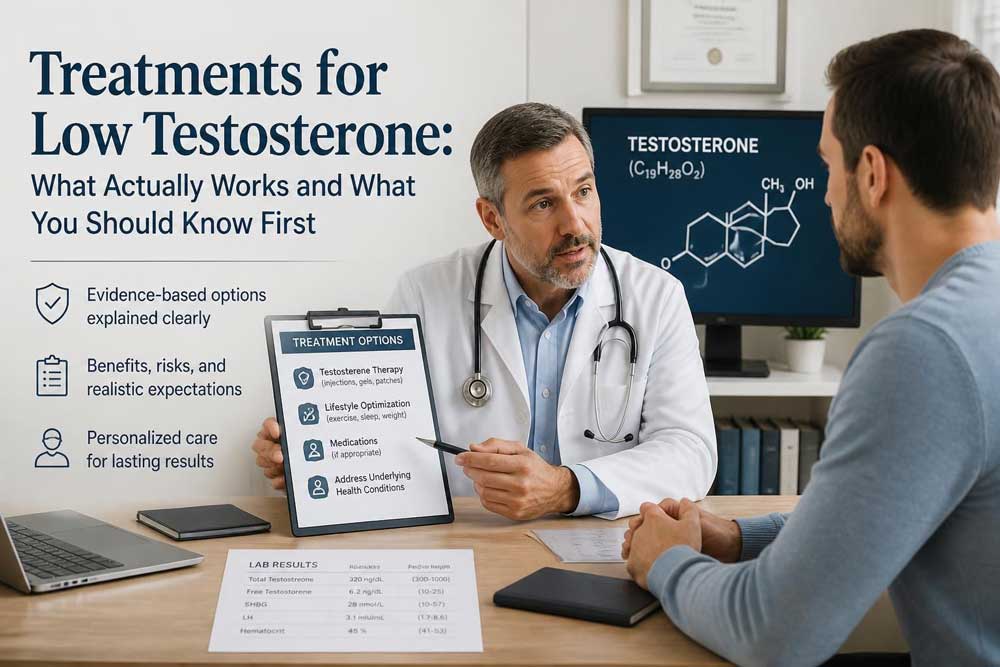
Treatments for Low Testosterone: What Actually Works and What You Should Know First
Low testosterone is more common than most men realize. Estimates suggest that roughly 2 in 100 men have clinically low testosterone, and that number climbs significantly as men age past 40. Yet despite how widespread the condition is, the information available is often either overly clinical or frustratingly vague.
If you have been feeling unusually tired, struggling with low libido, gaining weight without a clear reason, or noticing changes in your mood and focus, your testosterone levels could be part of the picture. The good news is that there are several legitimate, evidence-supported treatment options available. The challenge is knowing which ones are worth your time and which ones are mostly marketing.
This article breaks it all down clearly.
What Low Testosterone Actually Means
Testosterone is the primary male sex hormone. It plays a central role in muscle development, bone density, fat distribution, red blood cell production, mood regulation, and sexual function.
When levels drop below a clinically appropriate range, usually below 300 nanograms per deciliter (ng/dL) according to most clinical guidelines, it can affect nearly every system in the body.
This decline is not always dramatic. For many men, it’s a slow, gradual shift that’s easy to attribute to aging, stress, or a busy lifestyle. That’s exactly why so many cases go undiagnosed for years.
Medical Treatments for Low Testosterone
Testosterone Replacement Therapy (TRT)
Testosterone replacement therapy, often called TRT, is the most widely prescribed medical treatment for low testosterone. It works by supplementing the body’s natural production with external testosterone, administered through several delivery methods.
- Injections are one of the most common approaches. They’re typically given every one to two weeks and are known for producing consistent, measurable results. The downside is that hormone levels can fluctuate between doses, leading to energy and mood swings for some men.
- Topical gels and patches offer a more steady delivery method. Applied daily to the skin, they maintain more stable hormone levels throughout the day. However, there’s a real risk of transferring the hormone to a partner or child through skin contact, which requires careful handling.
- Pellets are a longer-term option. Small pellets are implanted under the skin every three to six months, releasing testosterone gradually. Many men prefer this for the convenience, though the procedure is minor and does require a clinical setting.
TRT is not without risks. It can suppress the body’s own testosterone production, reduce sperm count, and may not be appropriate for men trying to preserve fertility. In some cases, it may also worsen untreated sleep apnea or increase red blood cell production to problematic levels. This is a serious medical decision that should only be made with a qualified healthcare provider after proper testing and follow-up monitoring.
Clomiphene Citrate (Clomid)
Clomiphene is technically a fertility drug, but it’s increasingly used off-label to treat low testosterone. Rather than replacing testosterone directly, it stimulates the pituitary gland to produce more of the hormones that signal the testes to create testosterone naturally.
For men concerned about fertility, this is often a preferred alternative to TRT because it doesn’t suppress sperm production. It’s taken as an oral tablet, which many men find more convenient than injections or gels.
Human Chorionic Gonadotropin (hCG)
HCG works similarly to clomiphene in that it encourages the body to produce its own testosterone rather than replacing it from an outside source. It’s sometimes used alongside TRT to maintain testicular function, but it can also be prescribed on its own.
Like any hormonal treatment, it carries potential side effects and needs careful medical supervision.
Lifestyle-Based Approaches That Genuinely Help
Medical treatment isn’t always the first or only step. Several lifestyle changes have real, documented effects on testosterone levels, particularly for men whose levels are low-normal or mildly deficient.
- Resistance training is one of the most consistently supported natural ways to boost testosterone. Heavy compound movements like squats, deadlifts, and bench press have been shown to produce meaningful hormonal responses, especially in men who are sedentary to begin with.
- Sleep quality matters enormously. Testosterone is primarily produced during deep sleep cycles. Men who consistently sleep less than six hours per night show significantly lower testosterone levels than those getting seven to nine hours.
- Body weight plays a direct role. Fat tissue converts testosterone into estrogen through a process called aromatization. Losing excess body fat, particularly abdominal fat, can meaningfully improve testosterone levels without any medication.
- Chronic stress is another significant factor. Elevated cortisol, the primary stress hormone, actively suppresses testosterone production. Managing stress through structured approaches, whether that’s exercise, therapy, breathwork, or reducing workload, is not just good general advice. It has direct hormonal implications. If you’re curious about how this connects to broader sexual health concerns, understanding the impact of stress on erectile function can help clarify just how interconnected these systems really are.
What About Testosterone Supplements?
Walk into any supplement store or search online, and you’ll find dozens of products marketed as testosterone boosters. Most of them contain ingredients like zinc, vitamin D, ashwagandha, fenugreek, and D-aspartic acid.
Some of these have mild supporting evidence, particularly for men who are deficient in specific nutrients like zinc or vitamin D. However, the evidence for most proprietary blends sold as “testosterone boosters” is thin. They are not regulated the same way prescription treatments are, and the dosages used in marketing copy rarely match those used in actual clinical trials.
That doesn’t mean all supplements are useless. It means the bar for evidence should be high, and your expectations should be grounded in reality. Before investing time and money into any supplement protocol, it’s worth reading up on what the research actually says about science-backed testosterone supplement outcomes so you can separate genuine options from overhyped ones.
How Low Testosterone Connects to Sexual Health and Erectile Function
One of the most common reasons men seek out information about testosterone is its connection to sexual performance. Low testosterone can reduce libido, contribute to erectile difficulties, and affect overall sexual confidence. But it’s worth understanding that erectile dysfunction is not always caused by low testosterone alone.
Cardiovascular health, stress, anxiety, relationship dynamics, and medications all play a role.
Treating testosterone levels in isolation may improve some symptoms but not others. A holistic approach, one that addresses physical, hormonal, and psychological contributors, is usually the most effective.
Knowing When to Seek Help
If you’ve been experiencing persistent fatigue, reduced sex drive, mood changes, difficulty concentrating, or unexplained weight gain, it’s worth getting your testosterone levels tested. A simple blood test can confirm whether low testosterone is a factor.
From there, a conversation with a qualified healthcare provider can help you decide whether medical treatment, lifestyle changes, or a combination of both makes the most sense for your situation. The important thing is not to dismiss the symptoms or assume they’re simply a normal part of aging.
Taking the Next Step
Low testosterone is a real medical condition with real treatment options. Whether that means pursuing a medically supervised hormone therapy program, making meaningful changes to your sleep, exercise, and stress habits, or investigating how hormonal health connects to your broader sexual wellbeing, there is a clear path forward.
If you’re noticing multiple symptoms and aren’t sure where the issues are coming from, learning more about the early signs of andropause may help you understand the bigger hormonal picture and give you a clearer starting point for that conversation with your doctor.